
The global market is not what it used to be. Today, it is common for enterprises to have departments, subsidiaries, partners, and most importantly customers around the globe.
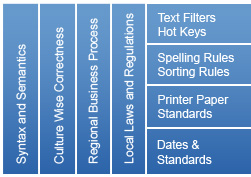
The user interface (UI), documentation, and content can be in multiple languages, currencies, date formats, and units of measurement. With such complexities, organizations need to ensure that their applications are relevant to the regions they serve. Localization testing ensures reliability, usability, acceptability, and above all relevance to audience and users worldwide. Products need to be localized and then tested on many counts like language/copy context, consistent functionality, compatibility, and interoperability.
Adhering to a region-by-region / country-by-country approach, QAExcellence testing services on the localization front include verification and validation of content, language, symbols, and terminology that ensures cultural sensitivity and alignment to local needs. Our testing process brings reliability, quality, and value to international and multilingual products. VnV test Lab has experience in designing and performing these tests on a myriad number of products in a variety of markets including financial services, e-learning, and security applications.
The main goal of localization testing is to
ensure compatibility and consistency across all localized versions.
We do this by defining a baseline standard, usually the native
version of the application under test. Additional tests are planned
and executed based on any specific changes needed to achieve proper
localization.
The main goal of localization testing is to ensure compatibility and consistency across all localized versions. We do this by defining a baseline standard, usually the native version of the application under test. Additional tests are planned and executed based on any specific changes needed to achieve proper localization.

"We were struggling as a business to meet our goals. After working with your team, we saw not only an instant boost in our morale, but also a boost in our sales."
Please feel free to use our Contact Us
page to email us as well.
Somnathnagar Society
Ahmedabad, Gujarat - 380052
Copyright | QAExcellence 2013